Infinity Chamber Analysis
01 Oct 2018Infinity Chamber is an independent science fiction movie, filmed on a low budget, with a more interesting story, better written characters, and more memorable visuals than its infinitely more expensive contemporary Blade Runner 2049. And you see, that’s a reflexive statement. Infinity Chamber exceeds in the areas it does because those are the areas that don’t require a great budget.
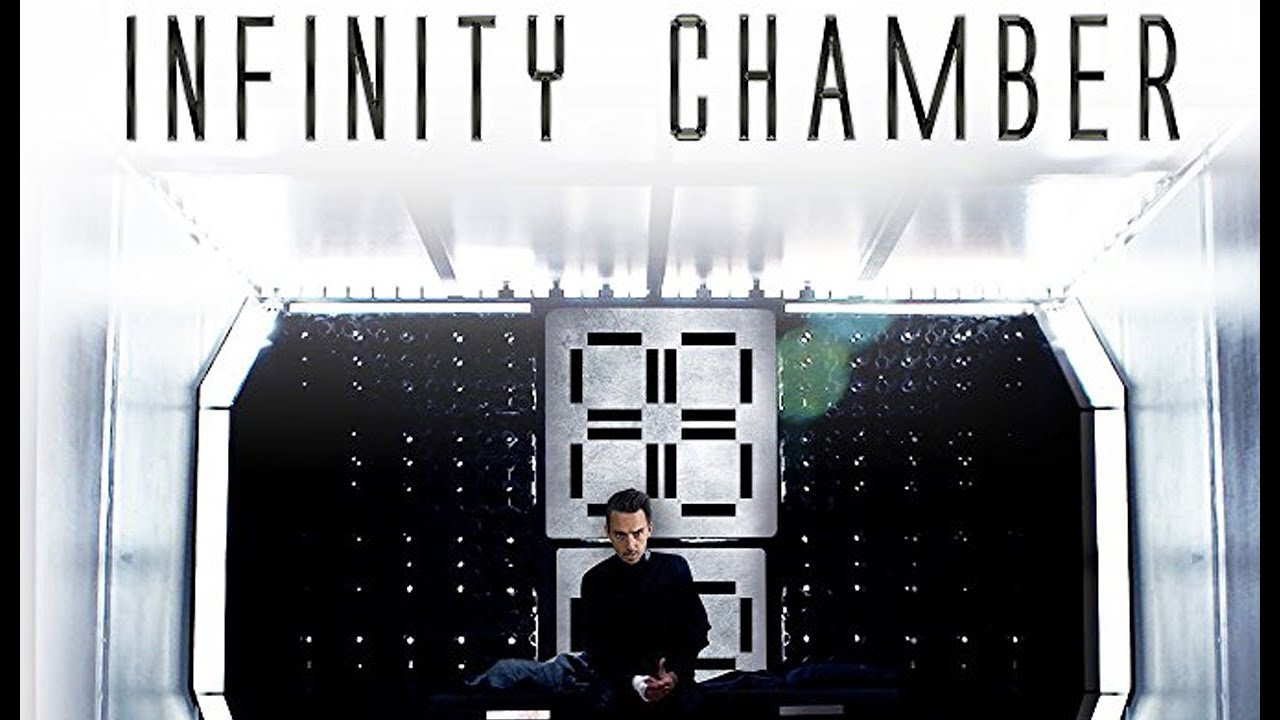
Like Cube 2 or The Exam the majority of Infinity Chamber’s story takes place in one small room and it features a small cast of characters. But in the case of Infinity Chamber this is most certainly not done to reduce budgeting costs on film locations. Interspersed throughout the movie are scenes sometimes only a few minutes long shot on exotic locations such as a desert or mountain range. These shots are as visually compelling as the rest of the movie. You know these places which you may only see for 3 minutes as intimately and accurately as the room you spend the rest of the movie in. It’s a product of the slow panning shots and followable cuts.
The story seems convoluted at first, and grows more so until a fairly big reveal that some may see coming, but which I certainly didn’t. After that things really do make sense. Even if the ending is ambiguous it’s ambiguous in a good way.
The story follows Frank, a man who’s been trapped in a high-tech, low-budget, solitary confinement cell. He has no idea who his imprisoners are, what they’re looking for, or how he can get out of their trap. The only interesting feature in his room is a slowly revolving disco ball inset in the wall. Frank is joined by his Life Support Operator Howard and his own imagination. Howard is an AI that is both quite clever at his job and exceedingly incompetent at everything else. We’ll be staying in this cell for the large majority of the movie and will seldom leave our main character Frank. This single-minded focus really grounds Infinity Chamber. The world we see is brought to us entirely through the mind of Frank.
After spending some time complaining to his AI companion Frank quickly figures out the purpose behind the weird rotating, pulsating device located at the far wall of his room. It’s interrogating him. Whenever he looks at it the device begins peering into Frank’s subconscious and forcing him to relive the memories of the day he was captured.
In Frank’s constantly repeating, Groundhog Day-esque memory sequence we have our third and final main character, Gabby. Gabby works as a barista at the coffee shop where Frank is stunned and kidnapped by a pair of armed government goons.
Because she is ostensibly a figment of Frank’s imagination she begins to remember Frank across cycles and the two form a good relationship centered around uncovering the secret of Frank’s imprisonment and finding a method of possible escape.
The concept of using the subconscious and dreams to revisit parts of the past has of course been done before. A notable example is terrible movie Source Code. Somehow, in that film the writers decided that revisiting parts of someone’s old memories could reveal real-world information that the original subject had no way of knowing. Going into the memories of one random passenger on a doomed train can somehow lead to finding both the bomb that killed everyone aboard and the criminal who planted the bomb.
Infinity Chamber makes no such insane claims. At one point Frank uses his resets to discover that he was captured because of a faulty biometric scan readout. However, even as he states his theory Gabby (Frank’s voice of reason) reminds him that his resets are nothing more than dreams and he could just be showing himself what he wants to see.
As Frank spends more time in the chamber it becomes evident that something has gone wrong. Power outages that can take down the lights, turn off the life support systems, and reset Howard’s memory begin happening more and more frequently. At one point during one of the worse outages Frank meets the prisoner in the cell adjacent to his. The man happily admits he is a member of the resistance (we get a couple of news clips about the resistance at the start of the movie so I guess it’s good foreshadowing) and explains to Frank how to avoid the mind-probing methods of the advanced interrogation device. The resistance member eventually admits defeat and chooses to kill himself rather than risk falling to the device. At this point Frank wakes up. Was it a dream induced by the device or did it really happen? Well Howard’s memory has been reset so Frank has no idea of knowing.
With the help of his tulpa girlfriend Gabby Frank devises a plan to escape the cell. Frank is able to trick his AI companion/imprisoner and escape his cell during one of the black outs. He exits the abandoned prison complex through a hatch and finds himself in the middle of a desert. He wanders about aimlessly in a visually impressive sequence (impressiveness bolstered by the fact that we’ve been bouncing around two sets for half a movie at this point). He eventually finds an oasis in the form of a nearby convenience story but quickly realizes he is experiencing another interrogation device induced hallucination and resets back to his cell.
Frank has now given up hope. The supplies of food and water keeping him alive have now dried up and his life support operator Howard still refuses to release him from his cell. In a very well written, yet not totally expected twist Frank reveals to Howard that he is indeed a resistance member. And our Frank isn’t just any resistance member, he’s the one who created the virus that may have just taken down the entire government including his own jail cell. Frank knows that there is no chance of escape now and he decides to end it all by hanging himself.
Howard tries to stop him and in the ensuing confusion Frank manages to escape again, this time with a little help from Howard. The second time around Frank decides to shut down the entire prison complex and finds himself stranded on a remote mountain range. Frank realizes that he is once again experiencing a hallucination and breaks down completely on the snowy ground. In his despair he is hailed by a pair of passing hikers.
Frank is not hallucinating, he has escaped and is saved by chance. Turns out part of the evil regime was overthrown shortly after Frank was imprisoned and wiped all the records their multiple illegal prison complexes. Frank is the sole survivor of his complex and is hailed as a hero for a short time.
Frank returns one last time to the coffee shop he has visited so many times before in his mind only to find that no, Gabby does not remember him and Gabby isn’t even Gabby. She was just wearing the wrong nametag the day Frank was captured. Lucky for him no-fear Frank is a smooth operator and there’s hope he can win her over for real this time.
Such a happy ending, no? After I finished the movie I thought so too for a while until I started thinking about it. Frank’s escape the second time led him through a complex looking exactly the same as his first, failed escape attempt. Sure the outside locations are quite different, but the interior complex is the same. Well maybe that can be written off for budgeting reasons or just simplification, but there are more problems.
Why doesn’t Gabby remember Frank? In every rendition of the past that we see Gabby is right there when Frank gets stunned. Surely she must have done something to stop his capture? And the government goons do not seem like the type of people to let her just walk away. And even if she just cowers in fear the whole time she surely should remember the man who she saw get kidnapped right in front of her. But again there are solutions to this problem. Maybe the goons carry short term memory erasing guns and used one on her. Maybe Frank has mis-remembered the kidnapping and in the real world he only got taken after leaving the coffee shop.
It is revealed later on in the film that the reason Frank keeps remembering the scene at the coffee shop is because that’s where he hid the USB drive storing the virus he created. At the end of the film Frank retrieves the virus at the coffee shop, and then promptly throws it away in the dumpster. For the life of me I cannot understand this one. Wouldn’t being forcibly kidnapped, sent to prison, and mentally tortured for months on end make Frank hate the government even more? It’s heavily implied that the new regime isn’t going to be much better than the old one so why doesn’t Frank take action? After the pain he’s went through and the time he’s lost wouldn’t he be rip-roaring ready-to-go crash the entire system to the ground? But no he’d rather give it all up and flirt with the coffee shop counter-girl.
If there is any better indication that Frank’s living in a dream world it’s that.
Frank did it. He told the shadowy government organization all they wanted to hear, but they can’t just let him go. No, they recalibrate the interrogation device and let Frank live out the rest of his life in another self-fabricated dream world. Maybe it’s another heinous act by an evil government, maybe it’s a mercy. Regardless, given the themes of the movie and the overall somber tone, it’s the most likely outcome.